
 Jyoti
Jyoti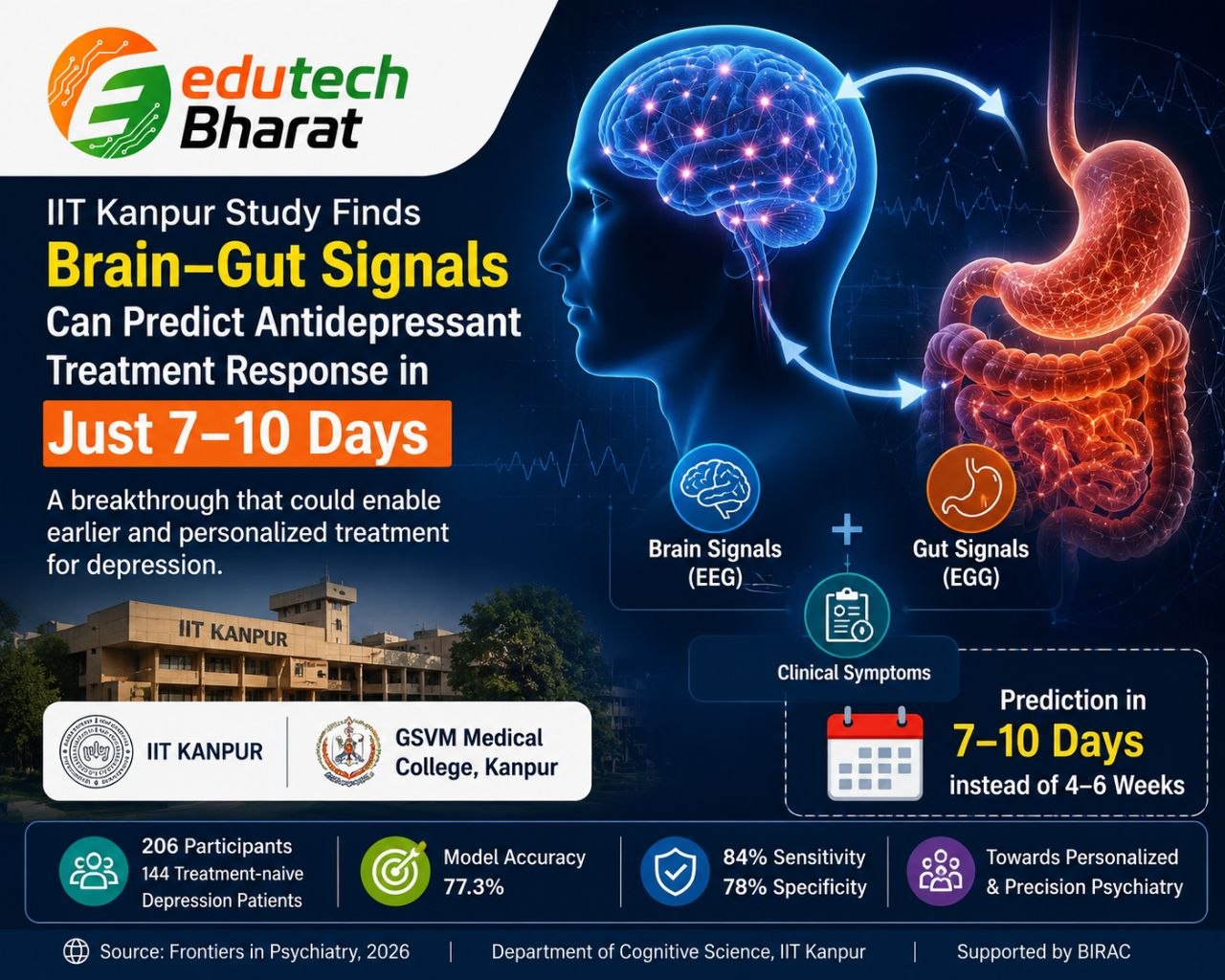
IIT Kanpur researchers found that Brain-Gut Signals, EEG, EGG and clinical symptoms may help predict antidepressant response within 7–10 days.
Kanpur : Researchers at IIT Kanpur and GSVM Medical College, Kanpur, have found that brain and stomach electrical signals, combined with clinical symptoms, may predict antidepressant treatment response within 7–10 days.
The study, involving 206 participants, offers a potential way to identify likely non-responders much earlier than the conventional 4–6-week assessment window, opening new possibilities for personalized depression treatment.

IIT Kanpur Research Could Change How Depression Treatment Is AssessedA new study by researchers at the Indian Institute of Technology Kanpur (IIT Kanpur), in collaboration with Ganesh Shankar Vidyarthi Memorial (GSVM) Medical College, Kanpur, has identified a potential method for predicting antidepressant treatment response within the first 7–10 days of therapy.
The research combines brain electrical activity, stomach electrical signals and clinical symptoms to identify patients who may be unlikely to respond adequately to an antidepressant.
The findings could be significant for depression treatment because doctors traditionally need several weeks to assess whether an antidepressant is producing an adequate response.
How IIT Kanpur’s Brain-Gut Approach Works
The researchers studied electrical activity from two systems—the brain and the stomach.They used:- Electroencephalography (EEG) to measure electrical activity in the brain.
– Electrogastrography (EGG) to measure electrical activity in the stomach.
– Clinical symptom data to capture the patient’s psychological and clinical profile.
EEG and EGG signals were recorded when treatment began and again approximately one week later. Researchers then examined whether these early biological signals could predict treatment outcomes measured 4–6 weeks after antidepressant therapy started.
Study Included 206 Participants
The study involved 206 participants, including 144 treatment-naive patients with depression.
Researchers collected EEG and EGG data at baseline and approximately one week after treatment began. The data were combined with clinical information to develop a predictive model for identifying potential antidepressant non-responders.
The findings indicate that useful information about eventual treatment response may already be present within the first 7–10 days.
Predictive Model Shows Promising Results
During model evaluation, the predictive model identified patients unlikely to respond to treatment with:- 84% sensitivity- 78% specificity
When tested on an independent patient cohort, the model achieved:- 77.3% overall accuracy- 80% specificity- 71.4% sensitivity for identifying non-responders
These results suggest that Brain-Gut electrophysiological signals, when combined with clinical information, could potentially support early prediction of antidepressant treatment response.
Why the Brain-Gut Connection Matters
The research also found that different symptom profiles were associated with distinct patterns of brain and gut physiology linked to treatment outcomes.
Dr. Pragathi Priyadharsini Balasubramani, Assistant Professor in IIT Kanpur’s Department of Cognitive Science and the study’s Corresponding Author, said that objective, non-invasive brain and gut electrophysiological signals collected around the first week of treatment already contain valuable information about treatment response.
Amal Jude Ashwin Francis, PhD Scholar in the Department of Cognitive Science at IIT Kanpur and the study’s First Author, said that recognizing biological subtypes could help explain why patients respond differently to the same medication.
Could This Reduce Antidepressant Trial and Error?
One of the biggest challenges in depression treatment is that the first prescribed antidepressant may not provide adequate benefit for every patient.When a medication does not work, patients may have to wait several weeks before treatment response can be properly assessed.
This can prolong the process of finding an effective treatment strategy.If the IIT Kanpur approach is validated in larger studies, early identification of likely non-responders could potentially allow clinicians to review treatment strategies sooner.
The approach could therefore contribute to personalized depression treatment and precision psychiatry.
From IIT Kanpur Research to Clinical Technology
The tools used in the study are currently accessible through Neuroclinical Innovative Solutions (NCIS) Private Limited.The translational project received financial support from the Biotechnology Industry Research Assistance Council (BIRAC), helping advance the research toward potential real-world clinical applications.
The objective is to develop technologies that could eventually support earlier and more personalized treatment decisions for patients with depression.
More Research Needed Before Wider Clinical Use
Despite the promising findings, researchers say additional validation will be necessary.Future studies involving larger and more diverse patient populations will be important to determine whether the predictive model performs consistently across different patient groups and clinical settings.
The research therefore represents a promising step toward earlier assessment of antidepressant response rather than a replacement for clinical diagnosis or medical decision-making.
Patients should not start, stop or change antidepressant medication without consulting a qualified healthcare professional.
What This IIT Kanpur Study Means for the Future
The study demonstrates the potential of combining EEG, EGG, Brain-Gut Signals and Clinical Symptoms to understand individual differences in antidepressant response.If further research confirms these findings, clinicians may eventually have access to non-invasive tools that provide useful information about treatment response much earlier than conventional assessment methods.
For depression care, that could mean moving closer to a model where treatment is not only evidence-based, but also earlier, more personalized and guided by measurable biological signals.
Research Publication
The study has been published in Frontiers in Psychiatry.