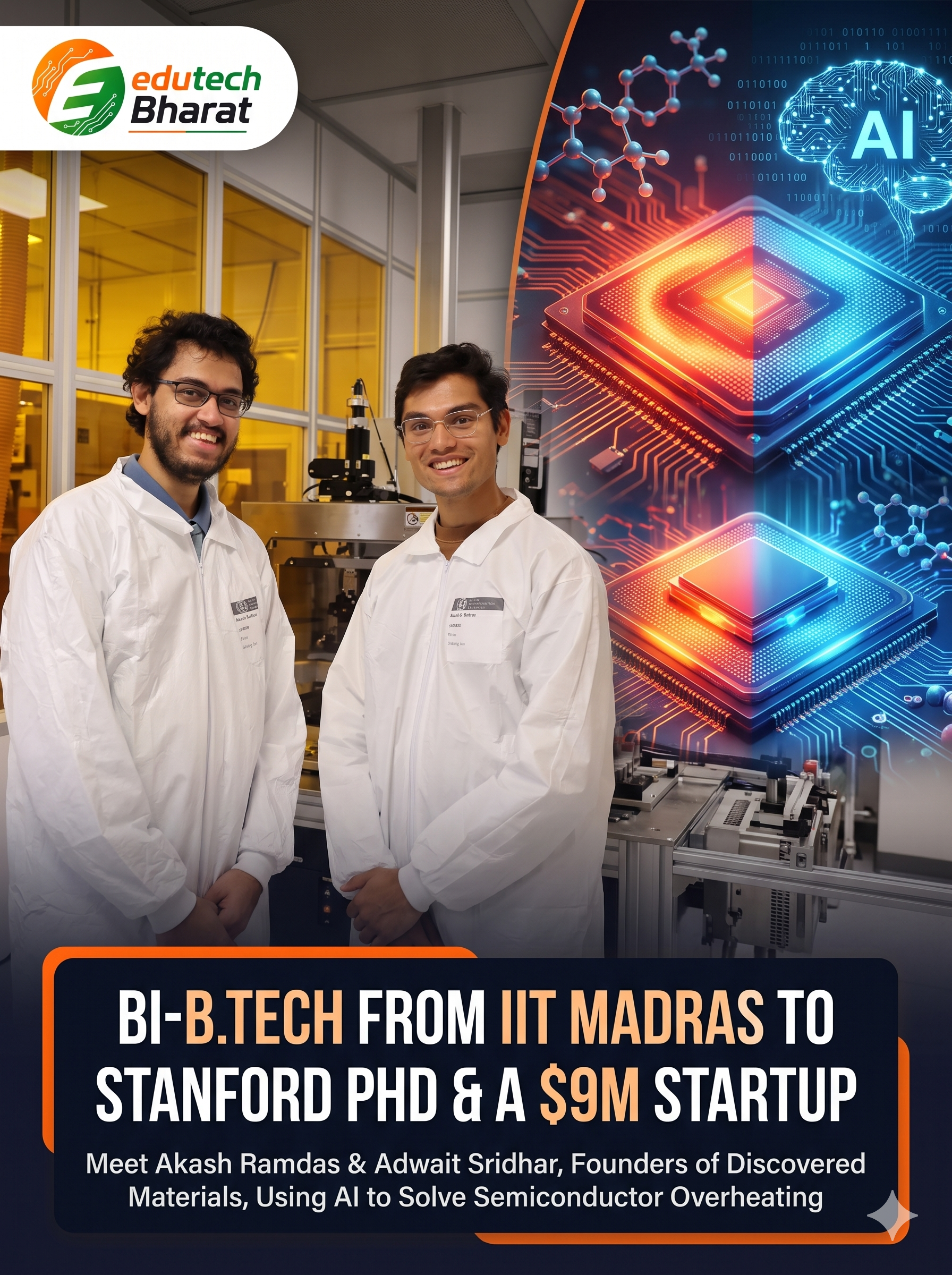
By Team EduTech Bharat
Key Highlights
- Founders: IIT Madras alumni Akash Ramdas and Adwait Sridhar.
- Academic Pedigree: Akash holds a B.Tech from IIT Madras and a Master’s & PhD from Stanford University.
- The Venture: Discovered Materials, a deeptech AI startup pioneering materials discovery.
- Funding: Secured $9 million in seed funding to scale operations and lab validation.
- Core Problem: AI chips produce immense heat; Discovered Materials deploys autonomous AI agents to discover high-efficiency thermal dissipation materials in record time.
The modern artificial intelligence boom is facing a physical bottleneck: extreme heat.
As graphics processing units (GPUs) and specialized AI accelerators pack tens of billions of transistors into microscopic footprints, the thermal energy they generate pushes hardware to its absolute physical limits. Standard cooling solutions and legacy thermal interface materials are struggling to keep up, capping performance gains and driving up data center energy demands.
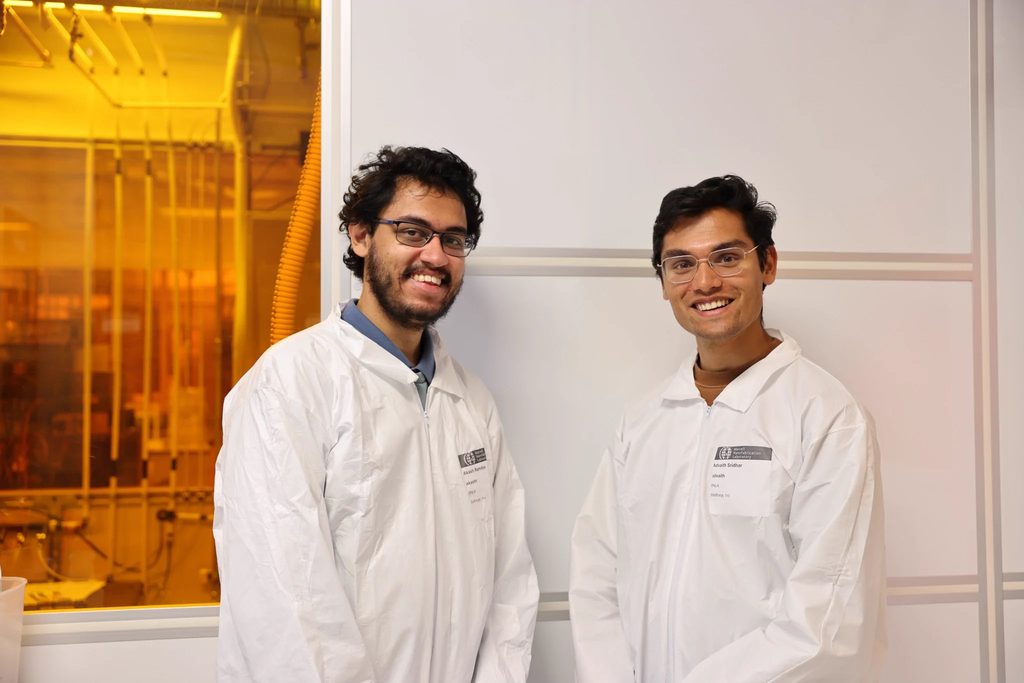
Tackling this high-stakes frontier is Akash Ramdas, an IIT Madras alumnus who went on to earn his Master’s and PhD from Stanford University. After a stint in research and corporate innovation at consumer goods giant Procter & Gamble, Ramdas chose to step away from corporate stability to enter the deeptech trenches.
Alongside his IIT Madras batchmate Adwait Sridhar, Ramdas co-founded Discovered Materials—a startup that recently secured $9 million in seed funding to rethink semiconductor material science from the ground up.
The Bottleneck: The Thermal Wall in Next-Gen Computing
Moore’s Law is no longer just limited by lithography; it is increasingly bottlenecked by thermodynamics.
When high-performance AI chips throttle under thermal stress, computing efficiency plunges. Discovering novel crystalline structures, alloys, or composite compounds capable of rapid heat dissipation has historically taken decades of trial-and-error laboratory synthesis, density functional theory (DFT) calculations, and iterative empirical testing.
This slow pace of physical chemistry cannot keep up with the exponential growth of compute workloads.
The Solution: Autonomous AI Agents for Material Discovery
Instead of relying solely on manual laboratory cycles, Discovered Materials builds specialized AI agents designed to compress decades of material science research into weeks:
- Massive Combinatorial Search: AI models evaluate millions of hypothetical molecular and atomic configurations to pinpoint candidates with superior thermal conductivity and mechanical stability.
- Predictive Property Modeling: The models screen out unfeasible compounds virtually before a single physical sample is synthesized.
- Closing the Loop: Insights from experimental validation feed directly back into the AI loop, refining the agents’ predictive accuracy with every cycle.
By targeting the semiconductor sector first, the startup aims to unlock new material layers that integrate directly into chip packaging and substrate architectures, allowing future AI processors to run faster, cooler, and with greater power efficiency.
The Bigger Picture for Indian DeepTech Talent
The journey of Akash Ramdas and Adwait Sridhar highlights an accelerating trend among premier Indian engineering graduates: moving beyond software-as-a-service (SaaS) and consumer tech into foundational hard-tech problems. Combining foundational engineering training from institutions like IIT Madras with advanced global research exposure at Stanford, founders in this space are positioning themselves at the core of the global semiconductor supply chain.
With $9 million in seed backing, Discovered Materials is now focused on expanding its computational chemistry teams and translating AI-predicted materials into commercially viable semiconductor applications.