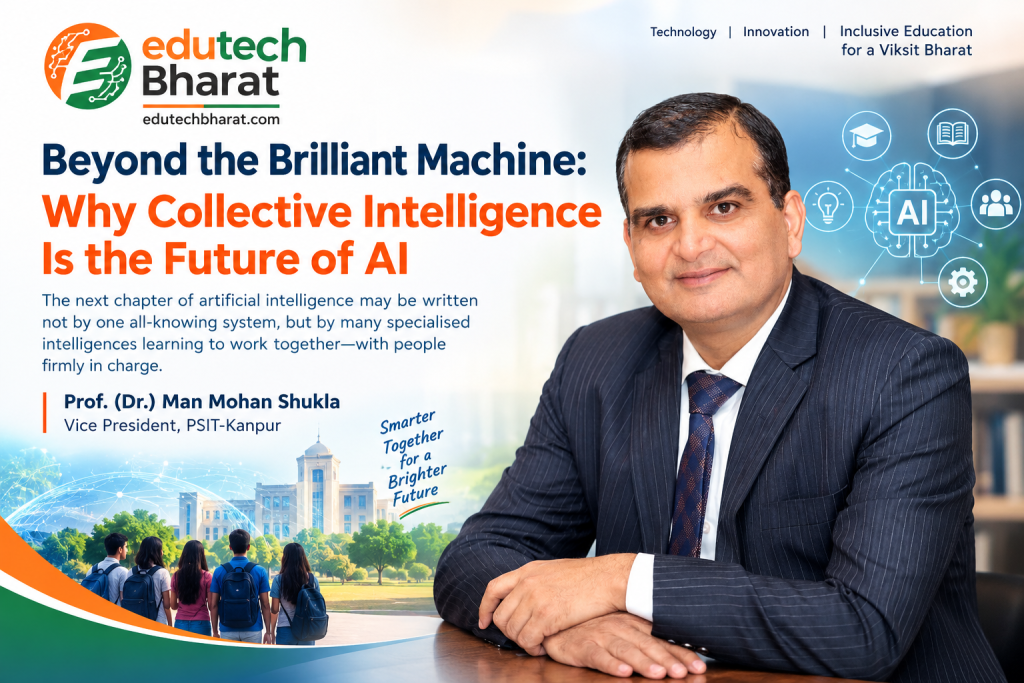

The next big leap in artificial intelligence may not come from a single all-powerful system, but from specialised AI agents working together—with humans guiding decisions, ensuring accountability and defining the purpose.
By Prof. (Dr.) Man Mohan Shukla
Vice President, PSIT, Kanpur
“The future belongs not to the loudest intelligence in the room, but to the wisdom that emerges when different minds work towards a common purpose.”
An Unexpected Lesson from a Rainy Evening
Imagine a city after a night of persistent rain. Underpasses are waterlogged, hospitals need information about accessible roads, schools must assess whether buses can operate safely, and residents are waiting for reliable updates.
No single source of information can resolve the situation. Weather forecasts, road conditions, transport schedules, public communication and emergency services must work together.
Now imagine an AI-powered system in which specialised agents perform different tasks. One analyses rainfall forecasts, another examines authorised traffic information, a third identifies routes to essential services, and a fourth prepares alerts for officials to review before publication.
This is an illustrative scenario, not an actual deployment. Yet it captures an important shift in artificial intelligence: from generating answers to supporting better decisions.
The real opportunity lies not in building a machine that claims to know everything, but in creating systems that help people understand complex situations and respond with greater confidence.
AI Is Becoming a Team Effort
Much of the public conversation around artificial intelligence has focused on its ability to write paragraphs, solve problems, generate images and answer questions. These capabilities are significant, but the challenges facing society rarely fit neatly into a single discipline or dataset.
This is where Multi-Agent AI enters the picture.
A multi-agent system brings together multiple software agents, each assigned a specific role. One may collect information, another compare alternatives, a third verify whether recommendations meet defined criteria, and another organise the findings for human review.
These agents can work sequentially or in parallel, depending on the task.
The model resembles a well-organised project team more than a magical machine. Each participant needs clear responsibilities, appropriate access to tools, reliable information and a mechanism for resolving disagreements.
However, adding more agents does not automatically produce better intelligence. For a straightforward task, a well-designed single AI application may be faster, cheaper and more reliable than a complex network.
The measure of collective intelligence is not how many agents participate, but whether their collaboration produces a better outcome.
From Isolated Answers to Connected Decisions
Consider the challenge of reducing electricity consumption across a university campus. Energy demand can vary with weather conditions, examination schedules, laboratory activity and building occupancy.
A conventional dashboard may show how much electricity was consumed yesterday. A coordinated AI system could potentially help facility managers understand why consumption changed and which interventions deserve attention.
One agent could analyse energy usage in individual buildings. Another could examine weather forecasts. A third could flag unusual consumption patterns and recommend an inspection. A fourth could assess proposed measures against comfort, safety and academic requirements.
Facility managers would retain responsibility for deciding whether to act on those recommendations.
The same approach could support accessible transport, public libraries and community infrastructure. A mobility assistant, for instance, could combine verified information about accessible routes, station facilities and service disruptions to help travellers compare practical options.
Crucially, the system must communicate uncertainty rather than present incomplete or conflicting information as established fact.
“Technology becomes truly meaningful when it turns scattered information into timely understanding—and leaves the final responsibility where it belongs.”
The Hidden Engineering Behind Seamless Cooperation
A collection of AI interfaces is not necessarily a reliable multi-agent system. Genuine collaboration requires careful engineering.
Developers must determine how tasks are assigned, what information each agent can access, when assistance from another agent is necessary and how outputs are checked. Some systems may use a central coordinator, while others rely on clearly defined handovers between agents.
Human approval becomes particularly important when an agent is about to send a message, modify a record or perform an action with significant consequences.
Interoperability is another essential requirement. The Agent2Agent (A2A) protocol, developed to facilitate communication between AI agents, is part of a broader effort to enable independently developed systems to work together. The Linux Foundation has provided a home for the protocol’s development.
Similarly, the US National Institute of Standards and Technology (NIST) has announced its AI Agent Standards Initiative, reflecting growing interest in the security, interoperability and trustworthiness of AI agents.
These developments point towards a wider principle: useful intelligence must also be controllable.
A reliable system needs more than an impressive demonstration. It requires testing, monitoring, fallback procedures, appropriate access controls and auditable records of approvals for consequential actions.

Why Human Judgment Must Remain Central
As automation advances, organisations may be tempted to measure success purely in terms of time saved or tasks completed. Efficiency matters, but institutions exist for purposes beyond efficiency.
Schools educate. Hospitals treat patients. Universities advance knowledge and human development. Technology that speeds up a process while weakening its human purpose cannot automatically be considered progress.
Consider an AI assistant supporting university admissions. It could answer routine questions about eligibility, application deadlines, courses and documentation. Yet a distressed applicant or someone facing an exceptional circumstance may need direct assistance from a human counsellor.
The objective should not be to eliminate human interaction, but to recognise when it is essential.
Trustworthy AI therefore requires transparency about uncertainty, accessibility, privacy safeguards and a meaningful opportunity to challenge decisions.
One of the most important principles is also one of the simplest: people should be able to understand a system’s role, correct its mistakes and stop a process when necessary.
A New Responsibility for Engineering Education
For institutions such as Pranveer Singh Institute of Technology (PSIT), Kanpur, the emergence of multi-agent AI creates an opportunity to prepare students for a more demanding technological landscape.
Students must learn to ask questions beyond whether a system can produce an answer.
How should tasks be distributed among agents? What happens when two agents reach conflicting conclusions? Which actions require human authorisation? How can a system be evaluated when its responses sound convincing but contain errors? And when does additional complexity stop delivering meaningful value?
These questions extend beyond computer science into ethics, management, design and social responsibility.
Students could explore an AI-based campus accessibility guide that relies on validated information about ramps, lifts and accessible routes. They could develop a research assistant that compares claims across academic papers and flags statements requiring verification. They could also build multi-agent scheduling systems and test whether collaboration genuinely outperforms simpler alternatives.
The educational value lies not in the number of agents deployed, but in the discipline of identifying a real problem, validating the solution and acknowledging its limitations.
How India Can Lead by Solving the Right Problems
India’s technological future will depend not only on the sophistication of its AI systems, but also on the relevance of the problems they address.
The country’s linguistic diversity, expanding digital services, growing urban centres and varied local needs create opportunities to develop AI solutions grounded in everyday realities.
A multilingual public-information assistant could help citizens access verified instructions in languages they understand. A community resource platform could organise reliable information about water services, local facilities and maintenance requests. Accessibility-focused tools could help address barriers that conventional digital products often overlook.
These are possibilities rather than guaranteed outcomes. Their success would depend on reliable data, sound governance, affordability and respect for the communities they serve.
In many cases, the best solution may not be a sophisticated network of agents. It may be a simpler digital tool that supports people in performing a task more effectively.
Progress should ultimately be measured by practical usefulness, not technological complexity.
Building AI Around Human Purpose
Multi-agent AI offers a vision of software systems that can coordinate expertise across different domains, connect fragmented information and support more informed decisions.
The possibilities are exciting, but so are the responsibilities.
The engineers who shape this future will need to combine technical expertise with patience, verification and integrity. They must learn to innovate without abandoning critical thinking, pursue speed without compromising quality, and build systems that remain accountable to the people who use them.
The most important question is not whether AI can become more powerful. It is whether that power can be directed towards meaningful human goals.
“The finest technology does not diminish the human hand; it gives human imagination a steadier, wider reach.”
The next great breakthrough in artificial intelligence may therefore be less about building a machine that knows everything and more about creating systems that help us work, learn and care together.
The future of AI will not be defined by intelligence alone, but by how effectively intelligence collaborates—and how responsibly humans guide it.